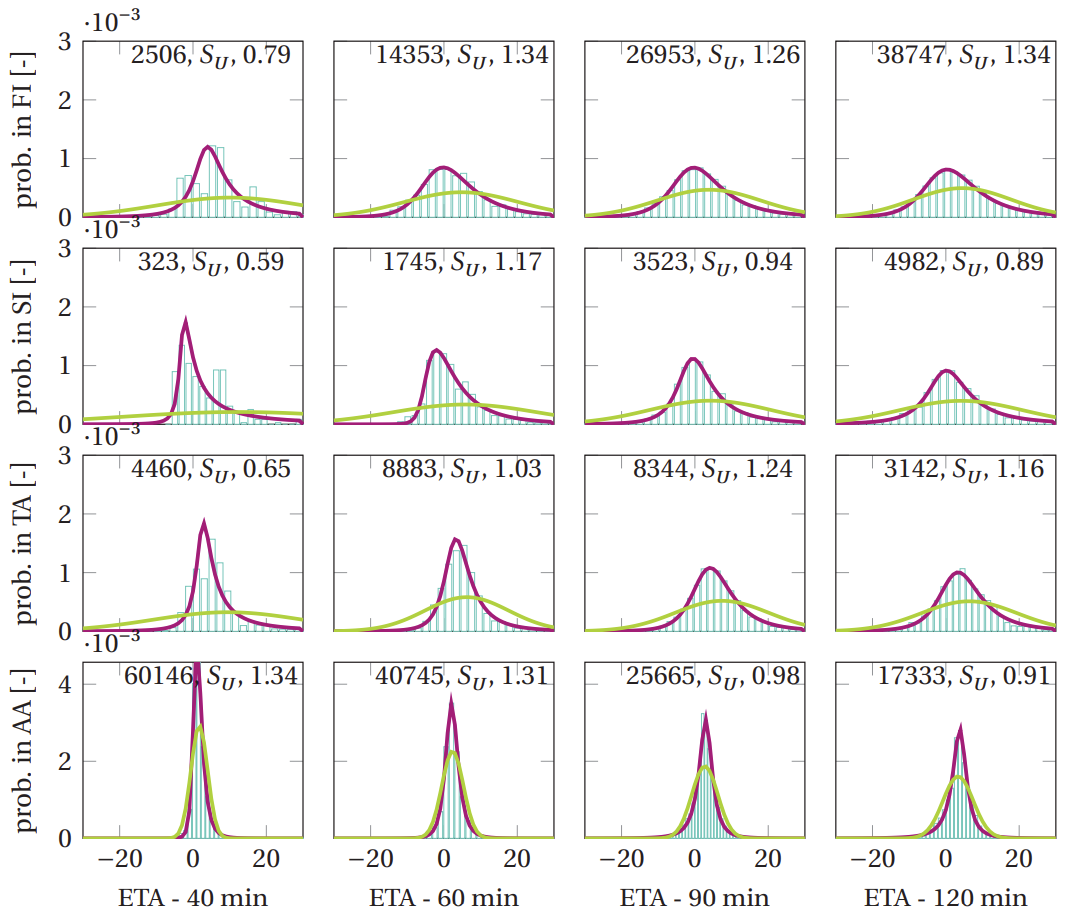
On the 21st of October last year I had the privilege to defend my dissertation titled: “Arrival Management in the Presence of Prediction Uncertainty”. In this blog, I will try to summarize what ended up being 11 years of work. It will describe where prediction uncertainty occurs, how the uncertainty may be determined and how that knowledge can be applied to visual interfaces and to algorithms.
Modern Air Traffic Management systems use prediction of a flight’s trajectory as the basis for controller support. These applications include Short Term Conflict Alert (STCA), Medium Term Conflict Detection and Resolution CD&R, Arrival Management (AMAN), and flow/network management. Deliberately the above collection is ranked in terms of prediction horizon: The horizon is often determined by our ability to make a sufficiently accurate prediction for the application in which it will be used.
The accuracy of the prediction depends on the knowledge of the initial state of the flight, the knowledge of future events (weather, the intent of the aircraft but also of air traffic control), the degree to which we can model factors that influence the trajectory. With increasing horizon, the number and type of future events – or disturbances – increases. Hence, if we are no longer able to know and model these, the chance of a deviation between the prediction and the actual flown trajectory increases.
Different uncertainties for different flights
A lot of research has been, and is still being done, on increasing our ability to model. However, for applications such as arrival management (which rely on a desired prediction accuracy in the other of 10 seconds), the desired horizon is too large however. The European Regulation for Common Project One requires an AMAN horizon of 180 nm for Europe’s largest airports. London Heathrow, Paris Charles de Gaulle, Frankfurt Airport are all within 180nm from Amsterdam Schiphol Airport. Arrival management then invariably would require prediction (to the same order of magnitude of 10 seconds) of processes on the ground. With A-CDM requirements currently using a scope of 5 minutes as acceptable, this seems an impossible task.
If accurate predictions are not available, the next option is to make the system robust for uncertainty. The approach taken in my dissertation is to make the knowledge of uncertainty an integral part of the decision-making process.
Predicting uncertainty
The prediction accuracy is a key performance parameter in any ATM algorithm. In testing of the design, a generic accuracy is often determined that applies to all flights for which a prediction is made. Such an approach disregards that the accuracy can vary from time to time and even from flight to flight.
By analysing predictions from the EURCONTROL Network Manager, the dissertation develops a method that evaluates the properties of a flight to determine the actual prediction uncertainty. In this way the previously described horizon could be dynamically changed based on the accuracies of the predictions at that moment. Benefitting from that requires making the abstract concept of uncertainty meaningful in regards to operational constraints.
Prediction uncertainty in arrival management manifests as an uncertainty in time. The uncertainty is therefore a property of a property of a flight. This makes the concept particularly hard to visualise. By showing the potential effect of the uncertainty on the arrival management timeline, the dissertation translated the concept into an effect that can be related to constraints in decision making.
The diagram proposed above proved hard to understand for experiment operators. One critical factor in their use of the diagram was the problem that uncertainty requires a different planning approach. Critical evaluation of the display ultimately provided another route to improve strategies. Based on the diagram an algorithm was developed that provides the horizon at which a sequence swap would be unlikely. Such an algorithm could support a dynamic working horizon based on the actual prediction uncertainty of the moment. A graduate student from the Delft University of Technology recently successfully applied the algorithm on a different prediction source to support debunching of inbound traffic.
Prediction uncertainty is a hard problem but here to stay in aviation. This work showed pathways to start using it as another piece of information in decision-making. Within To70 I hope to apply the knowledge gained during my PhD to support ATM in working with it, rather than trying to avoid it.
“In 2050 technologies and procedures available allow a 75% reduction in CO2 emissions per passenger kilometre to support the ATAG target and a 90% reduction in NOx emissions. The perceived noise emission of flying aircraft is reduced by 65%.”. This is what is stated in the EU’s vision for aviation Flightpath 2050[1]. To achieve this goal, the aviation sector is developing many new technologies across its whole value chain. Along with SAF and hydrogen propulsion, focus is being put in the development of fully electric aircraft. However, such technology poses major technical challenges due to the energy to weight and power to weight ratio of current battery technology. Hence, Hybrid Electric Propulsion System (HEPS) poses itself as a promising solution.
What is hybrid propulsion?
Hybrid electric propulsion, in the most general sense, combines an electric motor with an Internal Combustion Engine (ICE), or in more general sense a second power source, in a similar fashion to what is seen in current hybrid electric cars. In almost all designs the electric motor drives a propeller (the propulsor). For this reason, HEPS is being developed for either General Aviation (GA) aircraft or regional turboprops. The Internal Combustion Engine could also be substituted by a gas generator, or even by fuel cells [2]. The electrical energy to the motor can be provided either by a battery pack, or from an electrical generator. The latter converts the energy coming from the second power source into electrical energy.
When it comes to the powertrain design, three major architectures have emerged:
Series HEPS architecture,
Parallel HEPS architecture, and
Series-parallel HEPS architecture.
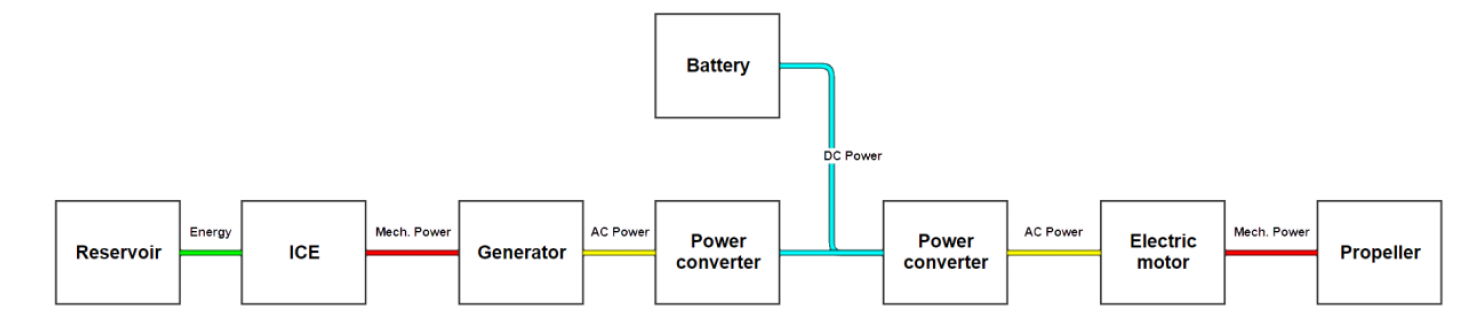
In the series configuration, the propeller is only driven by the electric motor. The (electrical) power to drive the motor is provided either by the battery and/or an electric generator coupled to the ICE.
Schematics of a series HEPS architecture (source: [2])
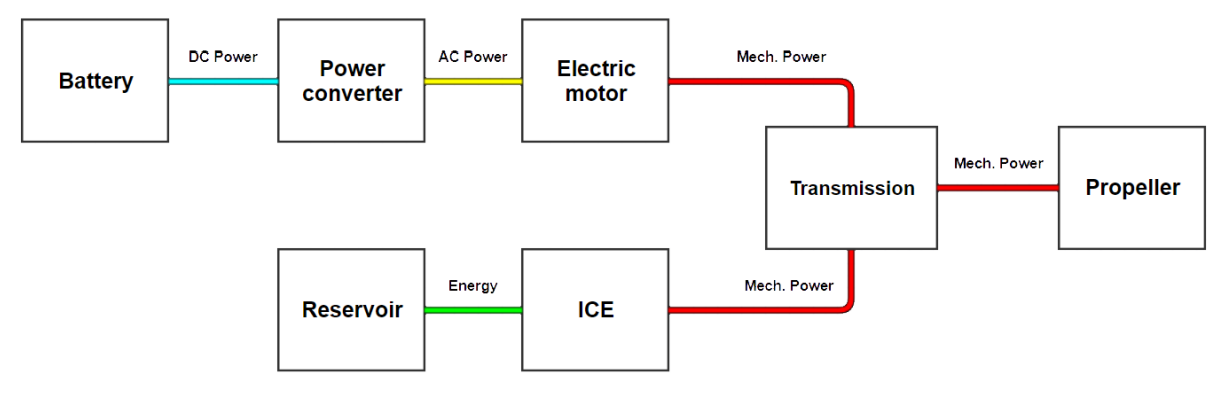
In the parallel architecture, mechanical power is provided both by an electric motor, powered by batteries, and by the ICE. The transmission couples both input mechanical power sources into a single output shaft to the propeller.
Schematics of a parallel HEPS architecture (source: [2])
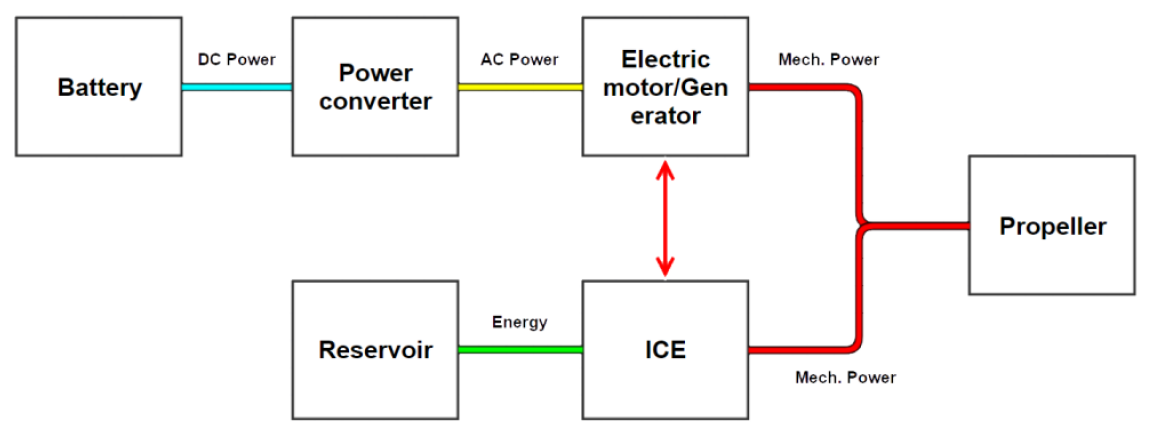
The series-parallel architecture, as the name suggests, combines the series architecture with the parallel one, and many different specific configurations have been developed. Although such configuration can be regarded as being the most advanced hybrid architecture, giving great flexibility in the design, it is also the most complex and heavy of the three.
Schematics of a possible configuration for series-parallel HEPS architecture (source: [2])
Benefits and drawbacks of hybrid electric propulsion
Hybrid electric propulsion shows promising advantages. In the series architecture, if the batteries have enough energy and power density, the aircraft could operate in fully electric mode. With current and projected battery technology, this could be achieved during the less power intensive phases of flight, such as descend and landing. For the latter, however, the full power needs in case of a take-off or go-around need to be carefully examined during the design of the powerplant. Furthermore, electrical energy is produced during the flight and can be stored in the batteries, allowing for an extended range and/or for fully electric operations for the final stages of the flight. Finally, from a safety perspective, having two separate power sources provides redundancy in the powertrain system, increasing the safety of such configuration.
Moreover, the series architecture is relatively simple: the propeller is only driven by one power source (the electric motor), hence eliminating the need of having complex and heavy gearboxes. Furthermore, the ICE can run at constant, optimal RPM, increasing its efficiency and hence requiring lower fuel burn. However, energy will be lost in the conversion phases (from mechanical to electrical, and from electrical to mechanical), even though electric generators and motors efficiency are quite high (in the order of around 90%) [3]. The need of a generator, which adds weight to the powertrain, is one of the major drawbacks of such design.
For the parallel architecture, the main advantage is that there is no need for an electrical generator; furthermore, the electric motor can be smaller, and hence lighter. However, such weight advantages are counteracted by the added complexity and associated mass of the gearbox, which has to combine two mechanical power inputs (electric motor and ICE) into one output shaft to the propeller.
A drawback that is common for all the HEPS design is that there is still the need for conventional fuel to power the aircraft, even if fuel consumption is lower compared to traditional aircraft. However, as for conventional aircraft, SAF could be used for HEPS powertrains as well.
The benefit of the potential reduction of the noise imprint of the aircraft deserves and article by itself, given the complexity of the topic. Research work is being done in this field. [4] focusses on the noise analysis for GA hybrid electric aircraft and concludes that a reduction of approximately 3 dB could be achieved when flying fully electric in the departure and climb phases of an airport traffic circuit. On the other hand, [5] compares the noise impact of a traditional ATR42 against a modified, hybrid version, concluding that the hybrid configuration could have a higher noise impact on the ground, both in terms of LAE and LDEN. Hence, definitive noise evaluations on hybrid electric propulsion cannot yet be drawn.
Overview of the current HEPS aircraft
In recent years, many aircraft testbeds have been developed to investigate hybrid electric propulsion.
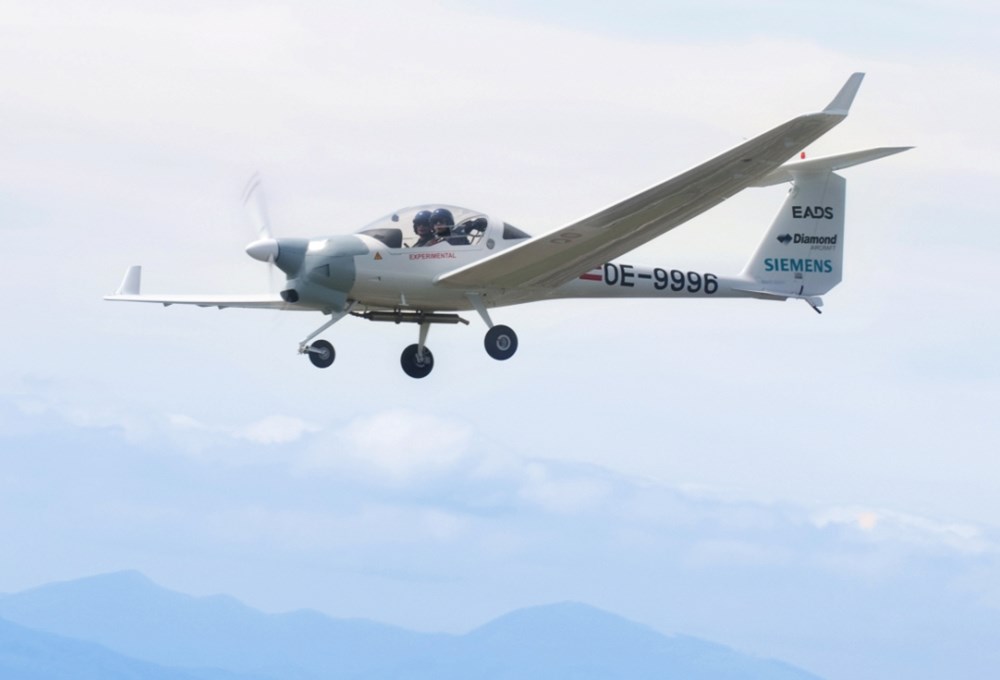
Diamond DA36 E-Star, featuring a series hybrid electric powertrain (Image source: [8]).
Starting with General Aviation, a consortium comprised of Siemens, EADS and Diamond Aircraft developed in 2011 the Diamond DA36 E-Star (and later in 2013 version 2) as one of the first hybrid electric aircraft suitable for commercial use. The aircraft features a series architecture, where the propeller is run by a 70 kW (94 hp) electric motor and electrical energy is provided by 30 kW (40 hp) reciprocating engine, coupled with a generator and battery packs. The company claims that this aircraft achieves a 25% reduction in fuel consumption and a drastic reduction in noise emissions during take-off [6]. Moreover, in 2018, the company announced the first flight of the world’s first multi-engine hybrid electric aircraft, based on the DA40 aircraft [7].
Within the EU funded HYPSTAIR (Hybrid Propulsion System for General Aviation Airplanes) project, a 200 kW serial HEPS has been developed and ground tested.
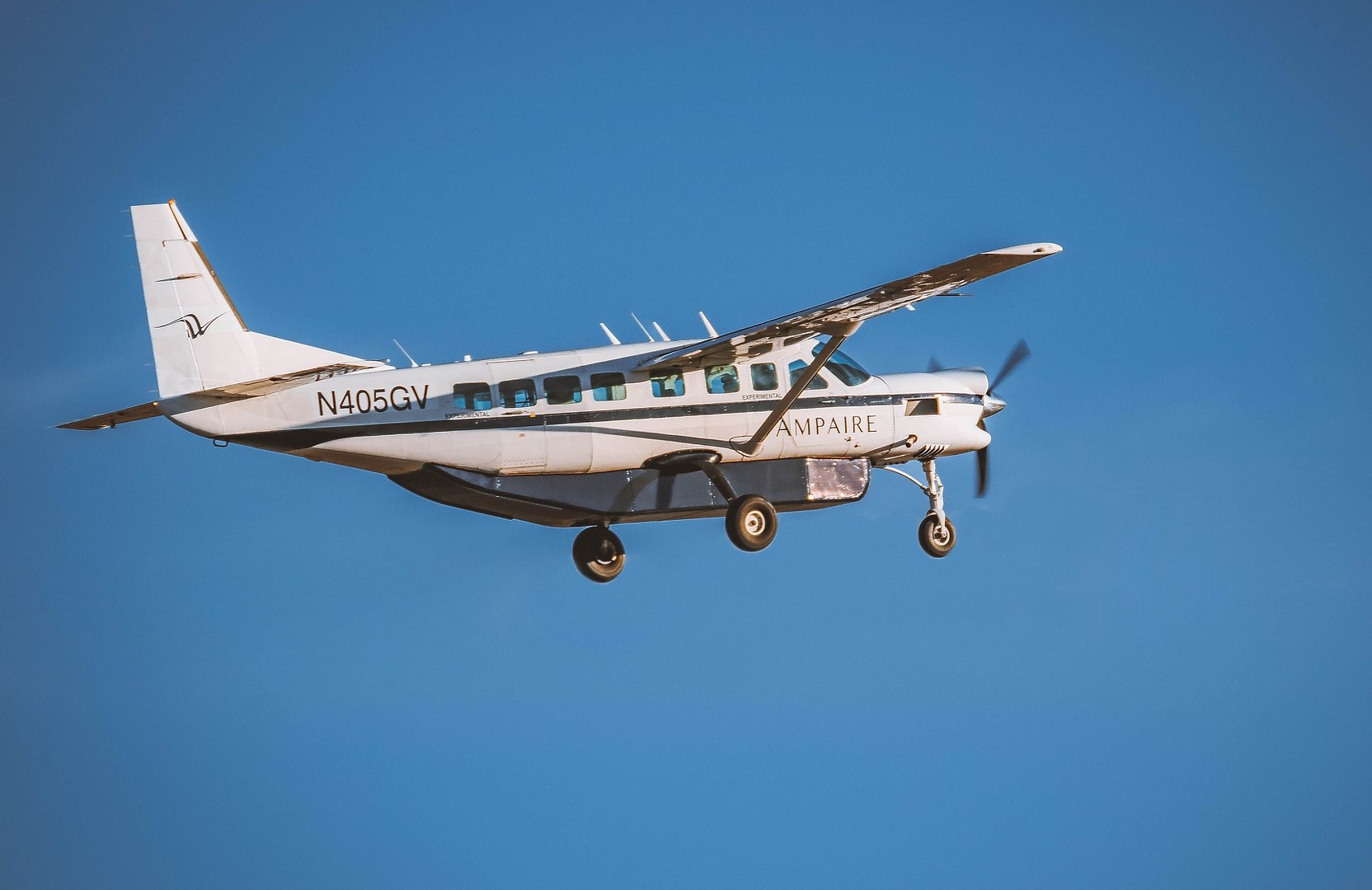
American based Ampaire is developing and testing different GA concepts. An hybrid electric retrofit of a Cessna 337 Skymaster is mainly being used as a tesbed aircraft for components, according to the company’s website. The manufacturer is also developing a modified Cessna 208B Grand Caravan, claiming that its emissions are the lowest in its class, with fuel savings between 50% and 70% [9].
Ampaire’s Cessna 208B Grand Caravan, retrofitted with an hybrid electric powertrain (Image source: [9]).
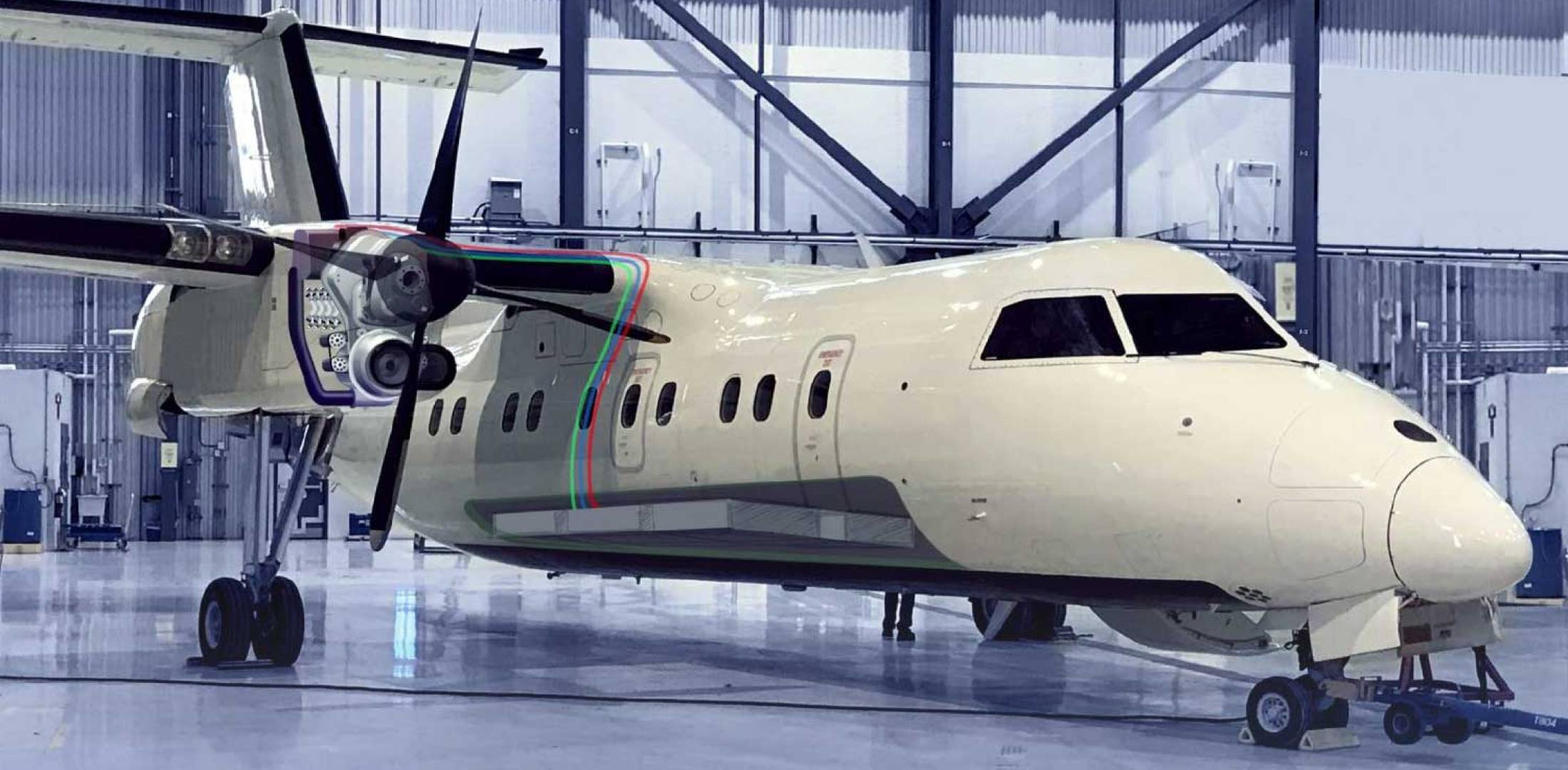
Demonstrators for regional propeller aircraft are also being developed. United Technologies (now part of Raytheon Technologies) is developing a hybrid electric testbed based on the Dash 8-100 twin turboprop. The aircraft is equipped with a parallel hybrid configuration on one of the two engines, with a 1 MW electric motor and an equally powerful 1 MW turboprop engine.
United Technologies hybrid-electric testbed: a retrofitted Bombardier Dash 8-100. Only one of the two turboprop engines is substituted with a parallel hybrid electric propulsor (Image source: [10])
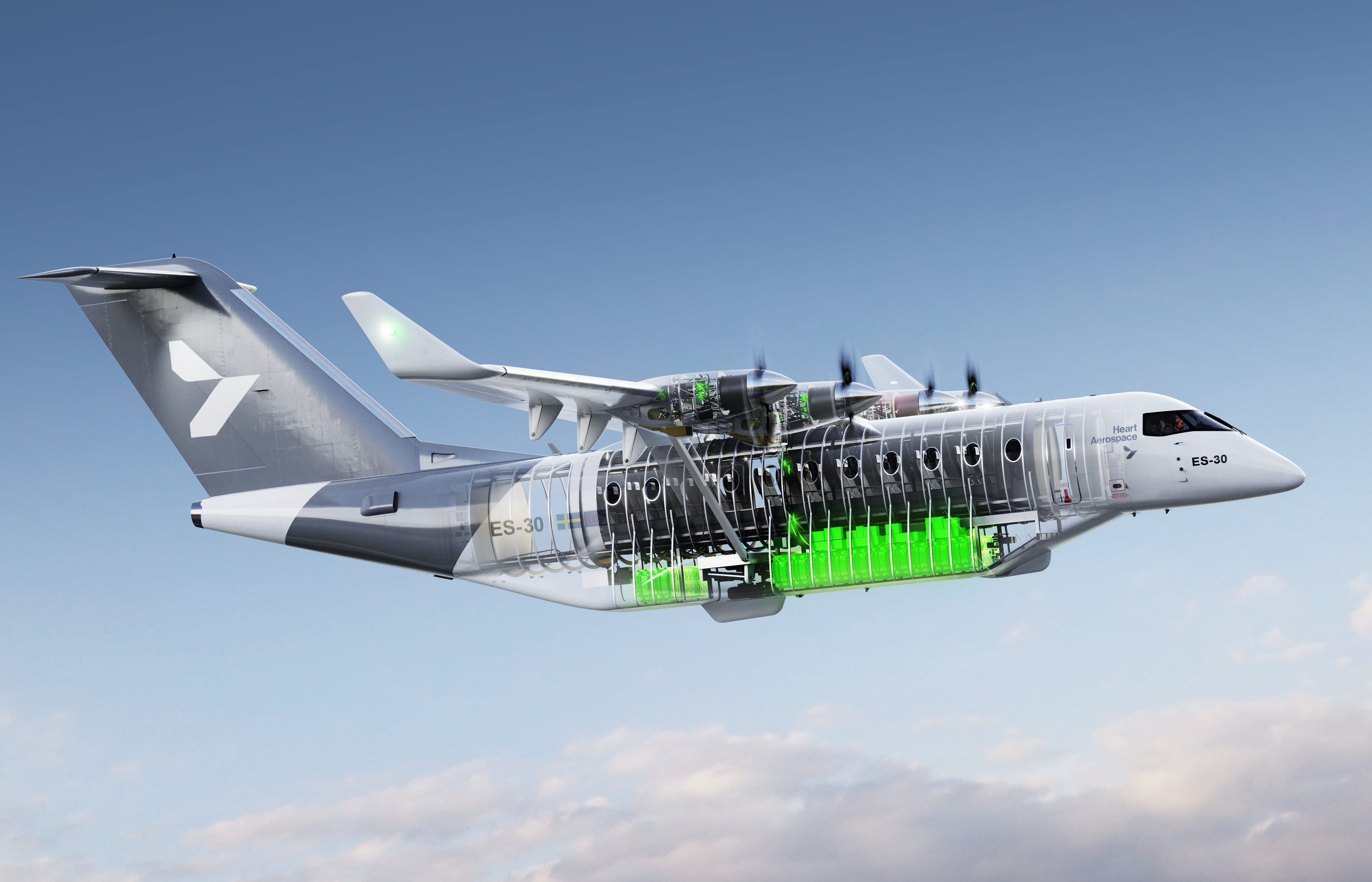
Swedish startup Heart Aerospace is developing a 30-seater hybrid electric aircraft. The company claims performance figures of 800 km of range in hybrid electric mode and a payload of 25 passengers, with an estimated EIS by 2028. [11]
Heart Aerospace ES-30, a 30 seater hybrid electric aircraft (Image source: [12]).
To wrap it up
Hybrid electric propulsion poses itself as interesting technology in the support for the decarbonization of the aviation sector. The presence of a conventional engine (either reciprocating or gas generator) allows for greater ranges and payloads compared to fully electric aircraft, whilst still promising lower fuel burns and emissions. The propulsive architecture allows for great design flexibility, which allows to explore different aircraft concepts. Many companies have started to experiment with such technology, which shows encouraging interest with regards to hybrid electric propulsion in the aviation sector.
[1] European Commission, Directorate-General for Mobility and Transport, Directorate-General for Research and Innovation, Flightpath 2050 : Europe’s vision for aviation : maintaining global leadership and serving society’s needs, Publications Office, 2011, https://data.europa.eu/doi/10.2777/50266
[2] F. Gaspari et al. “D1.1: Concept of Modular Architecture for Hybrid Electric Propulsion of Aircraft”. In: Deliverable D1.1 of the MAHEPA Consortium (2017).
[3] C. E.D. Riboldi, “An optimal approach to the preliminary design of small hybrid-electric aircraft”, Aerospace Science and Technology (2018)
[4] C.E.D. Riboldi et al, “Predicting the effect of electric and hybrid-electric aviation on acoustic pollution”, Noise Mapping (2020)
[5] A. Sollazzo et al, “Acoustic Impact of Hybrid-Electric DEP Aircraft Configuration at Airport Level”. Applied Sciences (2021)