Aviation safety concerns driven in 2025 as much by serious incidents as by accidents
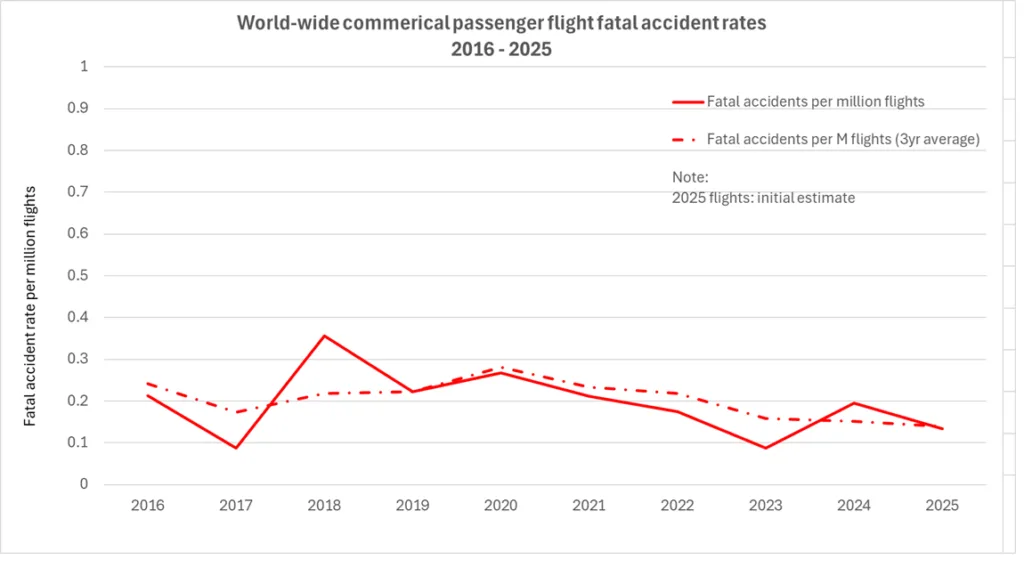
With five fatal accidents to the aeroplane types / types of operation that we survey each year (see note below) 2025 looks like another safe year. Fatal accidents are occurring at a rate of about one per 7 million flights (0.14 fatal accidents per million flights), a value slightly lower than last year’s 0.19 per million. As ever, fatal accidents in commercial aviation to large aircraft in passenger service remain a rare event.
However, there is absolutely no room for complacency; a word that EASA’s Executive Director Florian Guillermet used in the organisation’s Annual Safety Conference in November 2025[1]. Complacency itself is a safety risk. Whilst this article focuses on fatal accidents, complacency would, for example, have been shown if EASA had not taken swift action on the problem that space weather caused to a Jetblue Airbus A320 aeroplane at the end of October.
“In aviation, we have to constantly reconsider how safe we are,” said EASA[2]. The non-fatal accident rate is only just lower than the three-year moving average and a non-fatal accident occurred at a rate of 1.5 per million flights: 58 in total. Nearly half (24 occurrences) of these were related to in-flight turbulence – an accident type that passengers should be able to avoid by wearing their seats belts at all times when seated. 25 cabin crew members and 13 passengers were seriously injured. Our analysis does not include a much larger set of incidents whereby only minor incidents are sustained. For those readers that enjoy a legal definition, a minor injury – according to ICAO the UN’s aviation agency – means that the injury required less than 48-hour hospitalisation or was limited to only a simple fracture of fingers, toes or the nose. ICAO Annex 13 contains the full definition.
In total, 366 passengers and crew members lost their lives in large passenger commercial operations. This is nearly 100 more than last year. In addition, another 23 died as the result of the being involved in the accident. This includes, the three crew members of a US-military helicopter that struck the PSA Airlines aeroplanes in Washington DC, nineteen persons on the ground that were killed when an Air India Boeing 787 failed to gain altitude after take-off and one person – not being a crew member, passenger or airport worker – at Bergamo airport in Italy who ended his life by entering the engine of an aircraft that at the gate.
[1] [2] https://www.easa.europa.eu/en/newsroom-and-events/press-releases/easa-asc-2025-sees-complacency-safety-threat-seeks-rule
2025’s fatal accidents
There were five fatal accidents to large passenger aircraft in 2025. One was to a wide-body turbofan powered aeroplane, two were to narrowbody jets and two involved turboprop aeroplanes. The following is noted:
| Date (2025) | Type | Operator | State of Registration | State of Occurrence | Fatalities |
| 29 January | Canadair CRJ-700 | PSA Airlines | USA | USA | 64 +3 |
| 17 March | BAe Jetstream 32 | Lansha | Honduras | Honduras | 13 |
| 12 June | Boeing 787-8 | Air India | India | India | 241 +19 |
| 08 July | Airbus A319-100 | Volotea | Spain | Italy | 0 +1 |
| 24 July | Antonov AN-24 | Angara Airlines | Russia | Russia | 48 |
The four accidents to result in the deaths of more than 10 people in 2024 were as follows:
- Canadair CRJ-700 narrowbody jet in USA
The regional jet was on approach to Washington National Airport when it was struck by a military helicopter crossing the final approach path of runway 33. The procedures used by the military in this busy airspace were central to the investigation.
- Jetstream 32 turboprop in Honduras
Shortly after take-off, one of the aircraft’s two engines lost power and it ditched in the sea near Roatan. Only five of the 18 occupants survived.
- Boeing 787 widebody jet in India
Shortly after take-off, the aeroplane lost thrust on both engines and, failing to climb, crashed into a residential area that mainly houses doctors and nurses. Why the engines lost power has been the source of much speculation, but it is for the investigating authorities to make their findings known – at the time of publication, only their initial findings are known and the investigation continues.
- Antonov An-24 turboprop in Russia
Whilst attempting to land at Tynda airport in Russia in poor weather, the aeroplane flew into the ground about 15 km short of the runway and caught fire – an accident type known as Controlled Flight into Terrain. The crew were attempting an NDB-approach – a non-precision approach that is no longer widely in use and is certainly less accurate than satellite-based approaches.
Some of the accidents that are not included in the review – due to their size or to the fact that are to cargo or military flights does not mean that the industry is ignoring them. They are not included here as the purpose of this document is to inform airline passengers as to the safety of large passenger aeroplanes.
A noteworthy and tragic accident occurred to a UPS cargo aeroplane in the US on 4 November. The left-hand engine and its mounting onto the wing, the pylon, separated on take-off from Memphis airport. It is believed that debris from that event entered the aeroplane’s centre engine further reducing the aeroplane’s ability to climb. The resulting accident, in an industrial estate, resulted in the deaths of the three crew members on board and a further eleven people on the ground. The US aviation authorities, FAA, quickly grounded the aeroplane type with an emergency Airworthiness Directive. This tool was later used to extend the measure to DC-10 aeroplanes still in service.
Together with the Air India accident, the aviation industry and its regulators need to be vigilant to the developments that take place close to an airport; third-party risks or safeguarding is an area of aviation safety that only works if a defined area of restricted development is respected[3].
In last year’s article, reference was made to the accident to Azerbaijan Airlines Flight 8243 on 25 December (Embraer 190) near Aktau, Kazakhstan. The question was raised as to whether or not the aircraft had been shot down and, if so, by whom. In October 2025, the Russian president admitted that Russian forces had, unintentionally, shot the aircraft. The issue of flight in conflict zones remains an important issue and is further complicated by the fact that the attack occurred 700 km from the Russian-Ukrainian border.
[3] This article makes no suggestions that the safeguarding around either airport was inadequate, but the accidents are illustrative of the issue.
The average fatal accident rate is close to the 10-year average
This is the eleventh year that this review has been published and it only covers accidents to the larger passenger aircraft used by most travellers. (See the criteria in the Note below.) The review includes all causes; technical failure, human error or unlawful interference.
The very low number of accidents makes occurrence reporting and analysis more and more important. The industry needs to learn from the pre-cursors to accidents before they happen. There is much information available to the aviation industry from incident data and the collection and analysis of routine data during normal events. Air operators of large aircraft, for example, collect data on hundreds of parameters, sometimes many times a second, during flight. Analysis of this data allows the operator to better understand how the aircraft are being used and make adjustments to procedures long before accidents occur.
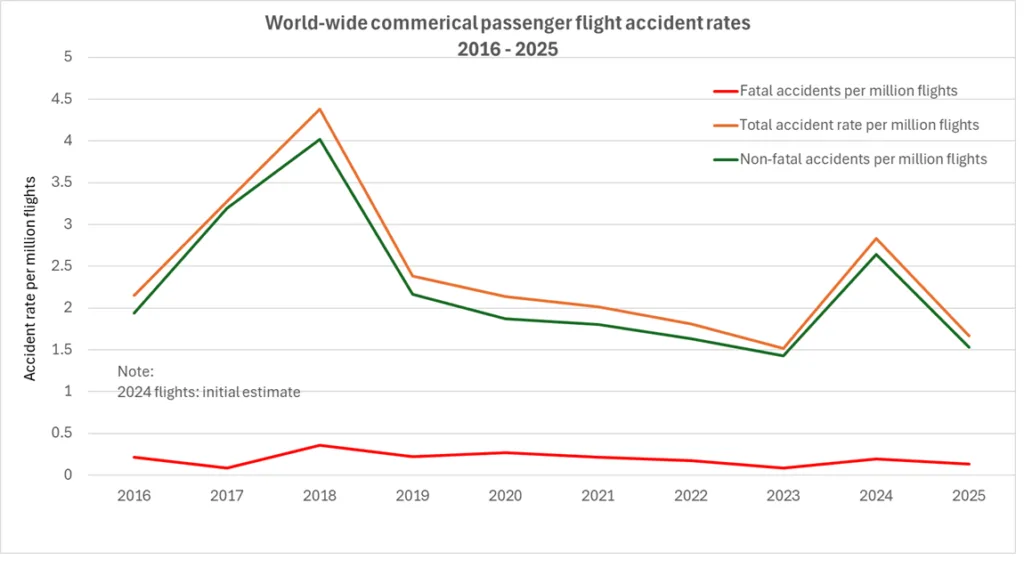
The total number of accidents in 2025 is lower than average and the fatal accident rate remains very low – the rate of fatal accidents per million flights has been below 0.4 since 2012.
Note: Methodology
A mix of sources is used to produce this article. Official figures reported by States to the UN’s aviation agency, ICAO, is used to determine the number of civil aviation flights that have taken place in any given year. The actual figures, published by the air transport organization, IATA, are used to estimate the current year’s figures.
Accident data is derived from publicly available databases, aviation authority websites and official sources such as ICAO’s ADREP database. The analysis documents accidents to passenger flights commercial air transport operations in aeroplanes with a maximum take-off mass of 5700 kg or above. This excludes a number of small commuter aeroplanes in service around the world, including the Cessna Caravan (maximum take-off mass 3629 kg). Certain relevant exceptions may be included regarding smaller turbo-prop aeroplanes just below this mass limit (e.g., the De Havilland Twin Otter with a maximum take-off mass of 5670 kg). Accidents to military flights, training flights, private flights, cargo operations and helicopters are excluded.
Unlike statistics produced by IATA and ICAO, accidents involving unlawful interference are included in our analysis.
As most commercial air transport operations take place with large aeroplanes, the effect of the excluded types on the accident rate is very small.
Note to editors
This is a product of To70, one of the world’s leading aviation consultancies. The draft version of this article is issued under embargo pending updates for the remainder of the year. In the event of a serious aviation accident close to the year’s end, the article may be withdrawn.
Recipients will be informed of changes and, if required, its withdrawal.
The article may not be used until 09:00 UTC (10:00 CET) on 1 January 2026.
Questions and requests for media contact may be directed to: Adrian Young, adrian.young@to70.eu, +31 (0)6 34 33 76 21